
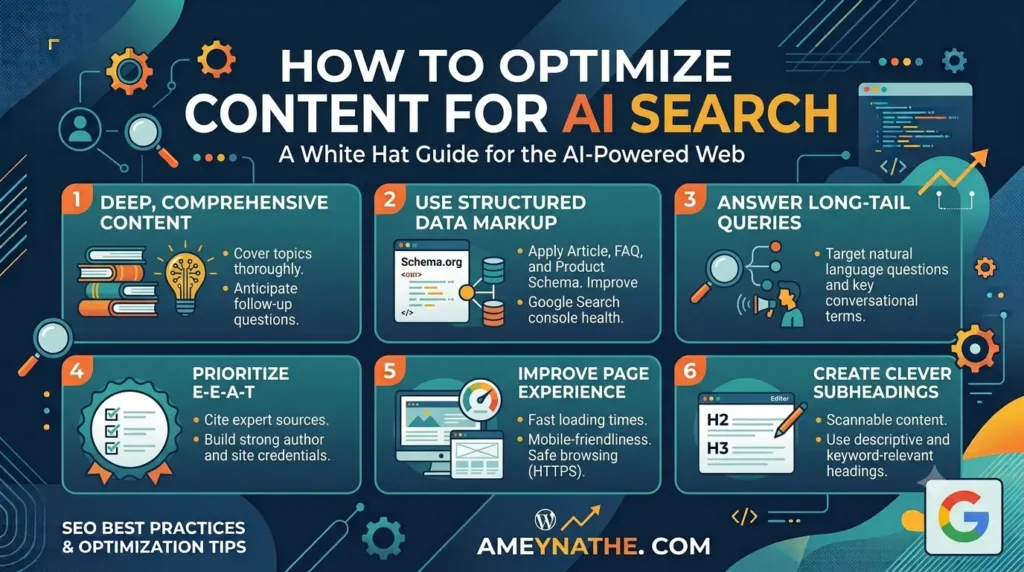
Learn How to Optimize Content for AI Search using SEO, E-E-A-T and people-first content strategies
A few years ago, content marketers had a predictable checklist.
Find a keyword. Write an article. Optimize the page. Build backlinks. Wait for rankings.
That formula worked because search was mostly about matching a user’s query with the most relevant webpages.
But search behaviour is changing. Today, someone might not search:
“best project management software”
They might ask:
“What project management tool should a small marketing team use if they need automation but don’t have a technical person?”
That is a completely different type of search.
The user is not looking for a keyword match.
They are looking for understanding.
So how do you optimize content for AI Search?
The answer is simpler than most marketers make it sound.
You create content that clearly answers real questions, demonstrates expertise, provides useful context and gives people a reason to trust your information.
AI Search does not eliminate SEO.
It raises the standard for what useful content looks like.
Google itself has stated that existing SEO best practices remain important for AI features such as AI Overviews and AI Mode. Google also emphasizes creating unique, valuable and non-commodity content rather than chasing special AI optimisation tricks. Google Search Central
What Is AI Search Optimization?
AI Search optimization is the process of creating content that can be easily understood, evaluated and surfaced by AI-powered search systems while still providing a great experience for human readers.
Unlike traditional search, where users usually scan a list of links, AI Search experiences attempt to understand the complete meaning behind a question and provide a more conversational response.
Think about the difference.
Traditional search:
“content marketing strategy”
AI Search-style query:
“How can a small business create a content marketing strategy without hiring a full-time team?”
The second question contains:
- a business situation,
- a limitation,
- a desired outcome,
- and an expectation for practical advice.
This is why AI Search optimization is not about inserting more keywords.
It is about understanding the problem behind the search.
Why AI Search Changes How Content Should Be Written
The biggest shift is moving from keyword targeting to information satisfaction.
For years, marketers focused on ranking for phrases.
But modern search systems are becoming better at understanding concepts, relationships and intent.
A page does not necessarily need to use the exact wording of a query to be relevant.
Instead, it needs to demonstrate that it understands the topic.
For example:
Someone searching:
“How does Google AI Overview work?”
may also want answers to:
- Does AI Overview replace SEO?
- How can websites appear in AI answers?
- Does structured data help AI Search?
- What type of content does Google trust?
A strong article anticipates these connected questions.
That is where many AI Search strategies fail.
They focus on writing for a machine instead of understanding the person.
Answer-First Content Gives Users What They Need Faster
One simple improvement can make a huge difference:
Answer the main question early.
Many traditional blogs start with a generic introduction:
“In today’s digital world, businesses are constantly looking for new ways…”
Readers have seen this thousands of times.
AI Search also benefits from clarity.
If someone searches:
“How do I optimize my content for AI Search?”
they should not have to read five paragraphs before finding the answer.
A stronger opening would be:
“Optimizing content for AI Search means creating useful, trustworthy and well-structured content that answers real user questions. The goal is not to manipulate AI systems but to make your content valuable enough to be referenced.”
Simple.
Clear.
Immediately useful.
This does not mean every article should become a short answer box.
Long-form content still has value.
The difference is that the reader should understand the purpose of the article within the first few paragraphs.
How Long-Tail Questions Improve AI Search Visibility
One of the biggest opportunities in AI Search is conversational queries.
People naturally ask questions.
They do not always think in keywords.
Examples:
Instead of:
“SEO trends 2026”
someone may search:
“What SEO strategies will still matter with AI search?”
Instead of:
“E-E-A-T”
someone may search:
“Why does Google care about experience and expertise?”
These longer questions reveal intent.
Should every article target dozens of long-tail keywords?
No.
This is where many marketers overcomplicate things.
The goal is not to create hundreds of pages targeting every possible variation.
Google has warned against creating content primarily to manipulate rankings through scaled content production. The focus should remain on creating helpful, reliable content for users. Google Search Central
A better approach is:
Find the main question.
Understand the related questions.
Answer them naturally in one genuinely useful resource.
Create Content That Shows Experience, Not Just Information
This is where E-E-A-T becomes important. Anyone can summarise information.
But experience is harder to copy. Imagine two articles about SEO.
Article one:
“SEO is important because search engines help businesses get traffic.”
Article two:
“After publishing multiple SEO articles, one thing becomes clear: indexing quickly does not guarantee rankings. Internal linking, topic consistency and search intent alignment influence how a website builds visibility over time.”
The second feels different.
Why?
Because it contains interpretation.
It sounds like someone has actually thought about the subject.
This is the type of content that builds trust.
E-E-A-T stands for:
Experience
Have you demonstrated practical understanding?
Expertise
Do you explain the topic accurately?
Authoritativeness
Are your claims supported by credible sources and recognised entities?
Trustworthiness
Are you transparent and reliable?
For AI Search, this matters because systems need signals that help distinguish useful information from generic summaries.
Building Context Through Entities, Not Just Keywords
One of the biggest differences between old-school SEO and modern search is how search engines understand topics.
Search engines are no longer only looking for matching words.
They are trying to understand:
- people,
- companies,
- products,
- concepts,
- relationships,
- and the broader meaning behind content.
This is where entities become important.
An entity is a clearly identifiable thing or concept that search systems can understand.
For example, an article about AI Search naturally connects with entities such as:
- Google Search
- Google AI Overviews
- Gemini
- ChatGPT Search
- Perplexity
- SEO
- content marketing
- E-E-A-T
But there is an important distinction.
Entity optimisation does not mean forcing brand names or technical terms into every paragraph.
That usually creates unnatural content.
Instead, explain the topic properly.
If you are writing about AI Search, discuss the technologies, platforms and concepts that are genuinely connected to the subject.
Context is what helps search systems understand the depth of your content.
Internal Linking Helps AI Systems Understand Your Expertise
Many marketers think internal links are only about passing SEO value.
They are also about creating a clearer content structure.
Think about your website like a library.
A single article sitting alone on a shelf gives limited context.
But when that article connects to related resources, it becomes part of a bigger knowledge system.
For example, a pillar article about AI Search could naturally link to supporting articles about:
- Google AI Overviews
- AEO vs SEO vs GEO
- E-E-A-T
- Technical SEO basics
- Content strategy
Then those supporting articles link back to the pillar guide.
This creates a topic cluster.
The benefit is not just search engines.
Readers also get a better journey.
Someone reading about AI Search may naturally want to understand how AI Overviews work next.
Good internal linking answers that next question before the user has to search again.
Structured Data Supports Understanding, Not Rankings by Itself
Structured data is another area where marketers often have unrealistic expectations.
A common question is:
Does schema markup automatically help content appear in AI Search results?
No.
Schema does not guarantee rankings or citations.
Its purpose is to help search engines better understand the information on a page.
Google continues to support structured data features such as Article markup, which can help search engines understand article details like headlines, authors and publishing information. (Google Search Central)
The important point:
Structured data is a communication tool.
It does not replace:
- useful content,
- expertise,
- authority,
- or a good user experience.
A perfectly marked-up article with poor information will still be a poor article.
Original Insights Make Content Harder to Replace
Here is where many content strategies struggle.
The internet already contains millions of articles explaining basic topics.
So why should an AI system or a reader choose your content?
Because you add something extra.
That could be:
- personal experience,
- original examples,
- unique analysis,
- expert commentary,
- practical frameworks,
- lessons learned.
Ask yourself:
If someone removed my brand name from this article, would there still be a reason to read it?
If the answer is no, the content probably needs more depth.
This is where content marketing becomes different from content production.
Production asks:
“How many articles can we publish?”
Marketing asks:
“What useful knowledge can we create that people remember?”
The second approach builds authority.
Common AI Search Optimization Mistakes Marketers Should Avoid
The excitement around AI Search has created many myths.
Let’s clear up a few.
Creating content only for AI systems
This is one of the biggest mistakes.
Content should not sound robotic because someone is trying to “optimise for AI.”
The best AI Search content is usually content that was already valuable to humans.
Adding unnecessary keywords
Keyword stuffing did not work well in traditional SEO.
It will not suddenly work in AI Search.
Natural language wins.
Publishing hundreds of similar articles
More content does not automatically mean more authority.
A website with 20 excellent resources can be more valuable than a website with 500 shallow pages.
Chasing every AI SEO trend
Every few months, a new “AI Search hack” appears.
Some of these ideas may sound interesting, but sustainable visibility usually comes from fundamentals:
- useful content,
- technical accessibility,
- clear structure,
- expertise,
- trust.
Measuring Success in AI Search Requires a New Mindset
For years, marketers focused on rankings.
That metric still matters.
But AI Search introduces more questions:
- Is my content appearing for broader queries?
- Are impressions increasing?
- Are users finding my content through informational searches?
- Are supporting pages strengthening my main topics?
Google Search Console has introduced reporting for generative AI search performance, helping websites understand visibility from AI-powered search experiences. (Google Search Central)
This shift is important.
The goal is not simply chasing a position.
The goal is understanding whether your content is becoming a useful source within a changing search ecosystem.
The Future of AI Search Belongs to Helpful Brands
There is a temptation to think AI Search requires a completely new marketing playbook.
It doesn’t. The fundamentals remain surprisingly familiar. Understand your audience. Answer real questions.
Create useful resources. Build trust. Support your claims.
Improve your expertise over time.
The difference is that search engines are becoming better at recognising whether content actually helps people.
And that changes the competition. The advantage will not belong to websites publishing the most.
It will belong to websites that understand their audience better.
The future of SEO is not about creating content that can be found.
It is about creating content that deserves to be found.
Frequently Asked Questions
How do I optimize my content for AI Search?
Optimize content for AI Search by creating helpful, well-structured pages that answer real user questions, demonstrate expertise and provide information that goes beyond generic summaries.
Does AI Search replace traditional SEO?
No. Traditional SEO remains important because AI search systems still rely on crawling, indexing, relevance and content quality signals to understand websites.
Should I use AEO or GEO strategies for AI Search?
AEO and GEO can describe useful content approaches, but there are no guaranteed shortcuts. The strongest foundation remains helpful content, strong SEO practices and clear information architecture.
What type of content is more likely to be cited by AI systems?
Content that provides accurate information, original insights, expert perspectives and clear explanations has stronger potential to become a trusted reference.
How important is E-E-A-T for AI Search?
E-E-A-T is important because it helps demonstrate why content should be trusted. Experience, expertise, authority and transparency help differentiate useful content from generic information.
Sources & Further Reading
- Google Search Central — AI features and your website
https://developers.google.com/search/docs/appearance/ai-features - Google Search Central — AI optimization guide
https://developers.google.com/search/docs/fundamentals/ai-optimization-guide - Google Search Central — Article structured data
https://developers.google.com/search/docs/appearance/structured-data/article - Google Search Central — Generative AI performance reports
https://developers.google.com/search/blog/2026/06/gen-ai-performance-reports
Related Blogs
Google AI Overviews Are Changing SEO