
The Evolution from SEO to Search Everywhere Optimization
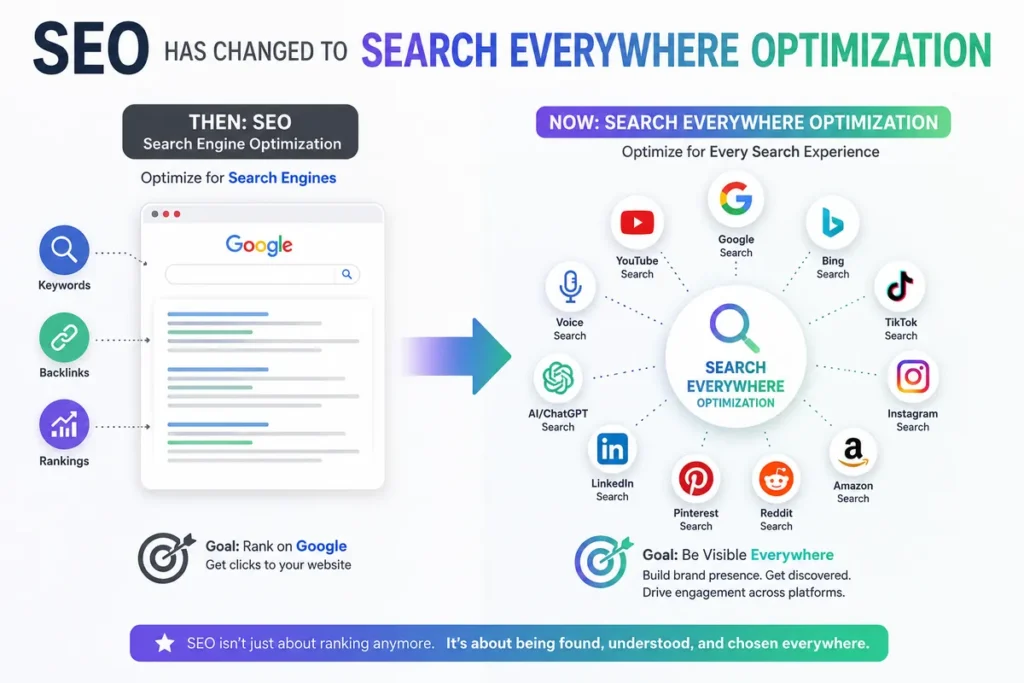
Why is Traditional SEO changing?
Hi, I’m Amey, a Digital Marketer and your SEO Guide.
A few years ago, digital marketers had a fairly straightforward job when it came to visibility online. If you wanted more traffic, you focused on Search Engine Optimization (SEO). You researched keywords, optimized web pages, built backlinks, and tried to rank higher on Google.
While those fundamentals still matter, something significant has changed in 2026.
People no longer search in one place.
Today, consumers discover information through multiple platforms depending on their needs.
Google still remains an important part of the customer journey, but it is no longer the only destination.
This shift has led to the rise of Search Everywhere Optimization, a novel approach to digital marketing that focuses on helping brands stay visible wherever people search, learn, compare, and make decisions.
So what is Search Everywhere Optimization?
It basically means being visible across several digital platforms and not just search engines alone.
Instead of relying exclusively on Google rankings, businesses now need visibility across:
- Search engines
- AI-powered search tools
- Social media platforms
- Video platforms
- Online communities
- Creator ecosystems
- Voice search platforms
And the goal is simple: meet your audience wherever they are searching.
As consumer behaviour evolves, Search Everywhere Optimization is becoming one of the most important digital marketing strategies for businesses that want sustainable online visibility.
Why Traditional SEO Alone Is No Longer Enough
Traditional SEO remains a critical foundation for digital success. However, consumer search behaviour has become fragmented.
Consider a modern buying journey:
A user discovers a product through TikTok.
They read reviews on Reddit.
They watch a YouTube comparison video.
Then they search on Google for prices.
Lastly, they go on ChatGPT for detailed information before making a purchase.
In this scenario, the customer interacted with five different discovery platforms before converting.
Businesses that focus exclusively on Google rankings risk missing valuable opportunities throughout this journey.
What is AEO?
One of the most important concept in recent years is Answer Engine Optimization (AEO)
AEO focuses on helping content appear as direct answers to user questions.
When someone asks a question through Google, voice search, or AI-powered assistants, search platforms increasingly try to provide immediate answers instead of simply displaying a list of links.
Examples include:
- Featured snippets
- Google AI Overviews
- Voice search results
- Knowledge panels
- Question-and-answer sections
Just a tip to improve AEO performance, businesses should focus on these factors:
- Answer questions directly
- Use clear heading structures
- Include FAQ sections
- Write concise explanations
- Use structured data markup
- Focus on search intent
The easier your content is to understand, the higher the chances to get selected as an answer.
What is GEO?
Marketers now are largely focusing on Generative Engine Optimization (GEO)
It focuses on improving the likelihood that AI systems reference, cite, or summarize your content when generating responses.
AI tools such as ChatGPT, Gemini, Claude, and Perplexity are changing how people discover information.
Instead of visiting multiple websites, users can ask a single question and receive a summarized response in seconds.
This creates a new challenge for brands:
How do you remain visible when AI becomes the intermediary between your content and the user?
The answer lies in GEO.
Businesses can improve GEO by:
- Publishing original insights
- Demonstrating expertise
- Creating comprehensive content
- Maintaining factual accuracy
- Building topical authority
- Using clear content structures
AI systems tend to favour content that is trustworthy, informative, and well organized.
10 Search Everywhere Optimization Strategies for 2026
1. Understand Where Your Audience Searches
Every audience behaves differently.
Some industries thrive on YouTube. Others perform exceptionally well on LinkedIn or Reddit.
Before creating content, identify where your customers spend their time and how they search for information.
2. Create Content Around User Intent
The best-performing content solves problems.
Rather than focusing exclusively on keywords, understand the questions, concerns, and goals behind each search.
Intent-driven content naturally performs better for SEO, AEO, and GEO.
3. Invest in Video Content
Video has become one of the largest search channels online.
Platforms such as YouTube, Instagram Reels, and TikTok now influence discovery at every stage of the customer journey.
4. Build Topical Authority
Publishing isolated articles is no longer enough.
Create content clusters around core topics to demonstrate expertise and improve both SEO and GEO performance.
5. Optimize for Questions
Questions drive modern search behaviour.
Include FAQs, conversational headings, and direct answers throughout your content.
This improves Answer Engine Optimization and increases your chances of appearing in AI-generated responses.
6. Participate in Communities
Consumers increasingly trust discussions more than advertisements.
Contributing valuable insights on Reddit, Quora, and niche communities can strengthen brand visibility and credibility.
7. Repurpose Content Across Platforms
A single blog post can become:
- A LinkedIn article
- An Instagram carousel
- A YouTube video
- A newsletter
- A Reddit discussion
Smart distribution maximizes content value.
8. Focus on Platform SEO
Every platform has its own algorithm.
Make sure to optimize:
- Titles
- Captions
- Descriptions
- Alt text
- Hashtags
- Profile information
Visibility depends on platform-specific optimization.
9. Prioritize Authenticity
Consumers respond to genuine experiences and practical insights.
Authentic content often generates stronger engagement than highly polished marketing campaigns.
10. Think Omnichannel
Successful brands understand that customer journeys are not linear.
Visibility across multiple touchpoints creates more opportunities for discovery and conversion.
How Search Everywhere Optimization, AEO, and GEO Work Together
Many marketers view SEO, AEO, and GEO as separate disciplines.
In reality, they are interconnected.
- SEO helps search engines discover your content.
- AEO helps answer engines extract your content.
- GEO helps AI systems reference your content.
- Search Everywhere Optimization ensures visibility across the entire digital ecosystem.
The businesses that succeed in 2026 will be the ones that embrace all four approaches.
Final Thoughts
The future of digital marketing is no longer about ranking in one place.
It is about being discoverable wherever your audience searches.
Search Everywhere Optimization provides a framework for achieving that goal by combining traditional SEO, Answer Engine Optimization, and Generative Engine Optimization into a single strategy.
As search behaviour continues to evolve, businesses that invest in multi-platform visibility, helpful content, and genuine expertise will be better positioned to attract traffic, build trust, and grow sustainably.
The question is no longer whether people can find your business on Google.
The real question is whether they can find you everywhere.
Frequently Asked Questions (FAQ’s)
What is Search Everywhere Optimization?
Search Everywhere Optimization is a strategy focused on improving visibility across search engines, AI tools, social media platforms, video platforms, and online communities.
What is AEO?
Answer Engine Optimization (AEO) helps content appear as direct answers in search results, AI Overviews, and voice search experiences.
What is GEO?
Generative Engine Optimization (GEO) focuses on making content more discoverable and referenceable by AI-powered search systems and generative engines.
Is Search Everywhere Optimization replacing SEO?
No. Search Everywhere Optimization builds upon traditional SEO by expanding visibility across additional discovery platforms and AI-driven search environments.
Related Blogs: 10 SEO Tips for Beginners in 2026