Hey, I’m Amey, your SEO Guide!
A few years back, On-page SEO (or on page optimization) meant one thing: tweak your title tag, add in the keywords, add some headers, and voila, it’s done! That checklist is still relevant but it is not the whole story anymore.
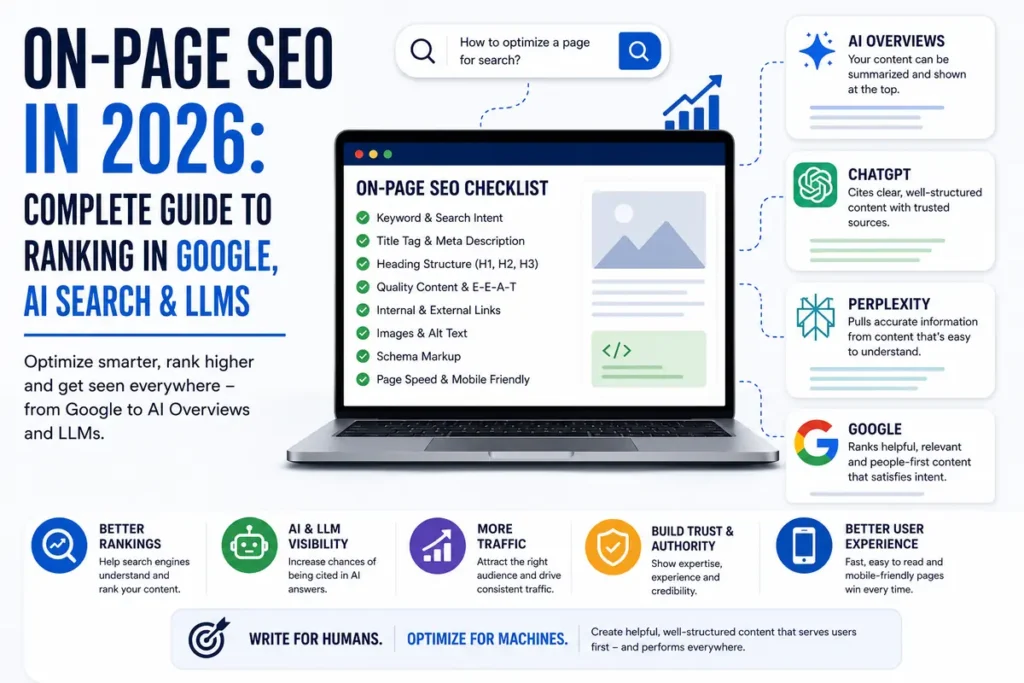
Your content now has to satisfy Google’s crawlers and hold up in front of AI Overviews, get quoted by ChatGPT, and show up inside a Perplexity answer. This blog post covers both the on-page fundamentals that never went out of style, and the AI-search layer that is quietly rewriting the rules.
What Is On-Page SEO?
On-page SEO is everything you directly control on your own site to help it rank which includes your writing, titles, headings, images, internal links. It’s different from Off-page SEO (backlinks, citations and mentions elsewhere) and Technical SEO (speed, crawlability, the behind-the-scenes plumbing). All three still matter, but on-page optimization is the one you actually touch every time you hit publish.
And the bar for great content keeps rising. Google is not ticking boxes anymore but it is trying to work out whether your page genuinely answers the question someone asked. Google’s ranking factors have now shifted from rewarding technical tricks toward rewarding pages that are simply useful.
But honestly if you ask me, the mantra is simple, which is to write for yourself when you are writing a blog post.
Why Does It Matter More Than Ever?
A huge share of searches now end without anyone clicking anything. AI Overviews summarize an answer before a person scrolls. Zero-click searches are quite common these days, and people are increasingly asking LLM’s or Large Language Models such as ChatGPT, Gemini, Perplexity, and Claude the same questions they used to type into Google search.
That sounds like bad news for publishers, and in some ways it is. But it also makes on-page SEO more important, not less, if an AI system is going to summarize your page, that page needs to actually be worth quoting.
Most importantly, thin and keyword-stuffed content does not appear in the search results whatsoever.
The Fundamentals That Still Work
- Start with keyword research: one primary keyword, a few supporting secondary keywords, and a real sense of search intent. Someone typing “on page seo checklist” wants something skimmable, not an essay. Layer in semantic keywords, related terms that show real understanding of the topic.
- Keep the URL clean (yourwebsite.com/on-page-seo-guide, not a string of random characters). Meta titles should be around 50–60 characters with the keyword worked in naturally. Meta descriptions run 150–160 characters and should give someone an actual reason to click.
- Heading structure matters more than it seems, one H1, H2s for major sections, H3’s underneath. It’s the difference between a page that reads like an outline and one that reads like a pile of paragraphs. When writing, resist repeating your keyword every other sentence; search engines caught onto that trick years ago.
- Don’t neglect images, compress them, use WebP, add real alt text instead of jamming a keyword in. Link internally to related posts and externally to sources you trust. Add schema markup (Article, FAQ, HowTo) so machines parse your page correctly, and deep dive into E-E-A-T Framework, show who wrote the piece and why they know the subject. Keep paragraphs short, watch your Core Web Vitals, and make sure everything works on mobile, since that’s where most traffic comes from anyway.
How AI Is Changing the Game
This is the part that’s genuinely new. AI Overviews summarize before anyone clicks, so your page needs to get to the point early, not three paragraphs into a windy intro. Search engines increasingly understand entities (people, places, brands, products) and how they connect, rather than just matching keyword strings. Some call this entity optimization or knowledge graph SEO.
That’s the heart of semantic SEO, sometimes called semantic or contextual search, covering the ground around your topic instead of repeating one phrase. It also means writing more conversationally, since nobody types “on page seo” into ChatGPT; they ask “how do I optimize my page for search?”
If you want tools like ChatGPT or Perplexity to actually cite you (people call this answer engine optimization or AEO in short, or citation optimization), the pattern holds: explain clearly, cite real sources, define your terms, back claims with real numbers. Under the hood, this leans on retrieval-augmented search, where these tools pull relevant chunks to build an answer, so content that’s cleanly structured with a direct answer up top gets pulled more often.
Worth remembering that Google isn’t the only game in town, Reddit, LinkedIn, YouTube, and Bing are all part of discovery now, an approach some call search everywhere optimization or GEO. And none of it works off one article alone, real topical authority comes from a cluster of connected content.
Quick Checklist
- Clear primary keyword and one well-defined H1
- Optimized title tag and meta description
- Internal links and compressed, alt-tagged images
- Schema markup and strong E-E-A-T signals
- Content formatted for AI to parse – direct answers & clean structure
- Fast, mobile-friendly page
FAQ’s
- What’s the difference between on-page SEO and AI SEO? Traditional on-page SEO targets classic search rankings. AI SEO (or GEO) is about getting your content understood and cited by tools like ChatGPT and Google’s AI Overviews.
- Does keyword stuffing still hurt rankings in 2026? Yes, both search engines and AI models are much better at spotting that now.
- Is schema markup actually necessary? Not strictly, but it’s worth doing. It helps search engines and AI crawlers understand the content on your page.